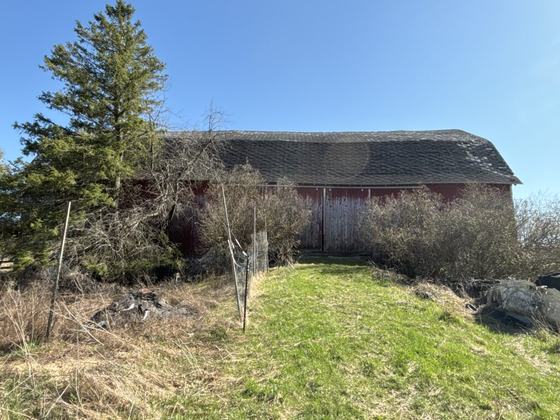
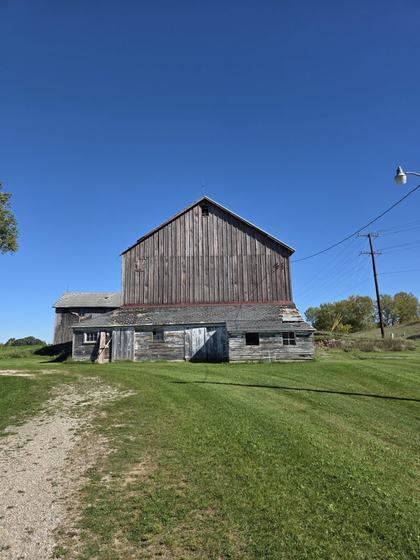
 Timber-frame barn 8 photos
Shiocton, WI
Late-1800s Timber-Frame Barn with Stone Foundation
Built late 1800s
Make an offer Barn to move
Listed Oct 2026
America's Dairyland built tens of thousands of dairy barns, and as small herds disappear many of them are for sale or free to a good home.
Barns posted by their owners, newest first. Most are sold to be taken down and moved. Click a barn for its photos, size, age and the seller's terms.
Wisconsin farm real estate averaged $6,700 an acre in 2026, up 4.4% in a year and above the US average of $4,500, with cropland at $7,600. Pasture rose fastest of the three land types, 6.1% to $3,500 an acre.
The classic Wisconsin barn is a gambrel or gable dairy barn on a fieldstone or concrete foundation, with a stable for cows below and a hay mow above, built between the 1880s and the 1930s. As small dairy farms have closed, many of these barns stand empty, and owners sell them with farmsteads or let buyers take them down for the wood.
| Land type | Wisconsin | US average |
|---|---|---|
| Farm real estate (land and buildings) | $6,700 | $4,500 |
| Cropland | $7,600 | $6,020 |
| Pasture | $3,500 | $2,000 |
| Change in farm real estate, 2025 to 2026 | +4.4% | +3.4% |
Source: USDA NASS, Land Values 2026 Summary, released July 31, 2026. Wisconsin farm real estate is 49% above the US average.
The counties between Green Bay and Milwaukee, such as Outagamie, Calumet, Manitowoc, Sheboygan and Fond du Lac, were settled largely by German farmers, and they built large barns on fieldstone foundations, many with silos alongside.
This is still active dairy country, so barns in use rarely sell, but empty barns on split-off farmsteads come up often. One listing on this site, a late-1800s timber-frame barn near Shiocton, comes from here.
Central Wisconsin's dairy farms, in Marathon, Clark, Portage and Waupaca counties, have gambrel barns from the early 1900s. Marathon County is also known for ginseng, grown under shade on farms around Wausau.
Land is cheaper here than in the east, and barns too far gone to save are sold for salvage. A 30 by 90 foot gambrel barn near Ringle on this site is an example.
The unglaciated hills of southwestern Wisconsin grew cigar tobacco, much of it by Norwegian farmers in Vernon and Dane counties, and long tobacco sheds with hinged vent boards still stand there. The region also has many of the state's round and polygonal barns.
Small valley farms here attract buyers from Madison and the Twin Cities, so prices are higher close to the cities and lower in the more remote ridges.
Our old barn inspection checklist covers the rest, and the guide to moving an old barn explains the costs if you plan to take one down and re-erect it.
Restoring a listed barn for business use may qualify for the 20% federal historic tax credit; see our barn tax credit guide.
Most were built for small dairy herds between the 1880s and 1930s. As those farms closed, owners stopped maintaining the barns and now sell them, or give them away, to anyone who will take them down.
In the southwest, especially Vernon, Dane and Rock counties, which grew cigar tobacco. The long sheds have hinged boards that open to let air cure the leaf.
Wisconsin farm real estate averaged $6,700 an acre in 2026, according to USDA, with cropland at $7,600 and pasture at $3,500.
List your Wisconsin barn on OldBarnsForSale.net for free and reach buyers looking for old barns.
List Your Barn