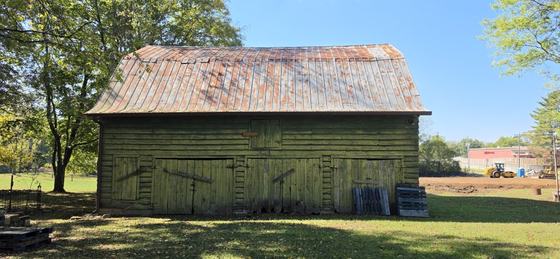
 Gambrel barn 7 photos
Monteagle, TN
Church-Owned Gambrel Barn on the Cumberland Plateau
Make an offer Barn to move
Listed Oct 2026
From log cribs in the north Georgia mountains to tobacco barns in the south Georgia belt, the state's old barns follow its three farm regions.
No Georgia barns are listed right now. Most barns below are sold to be taken down and moved, so buyers often look in nearby states.
Gambrel barn 7 photos Monteagle, TN
Listed Oct 2026
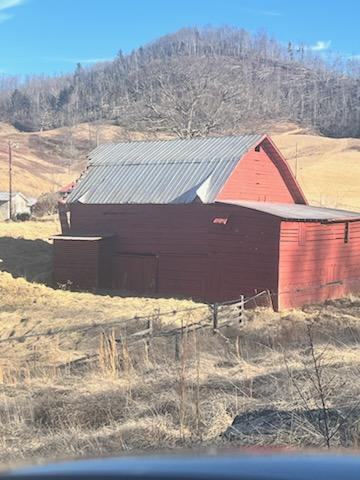 Gable barn 6 photos
Bakersville, NC
Built c. 1900
Listed Aug 2026
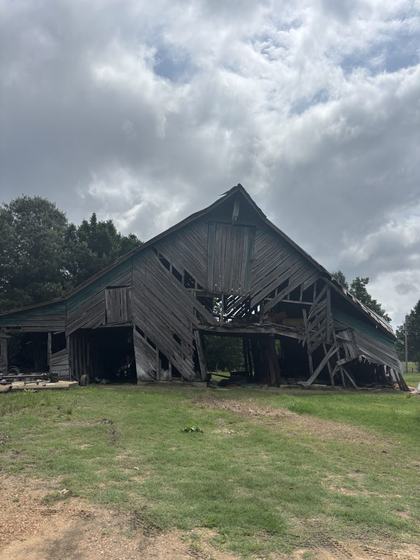 Gable barn 8 photos
Wynne, AR
Listed May 2026
Georgia farm real estate averaged $4,950 an acre in 2026, up 4.9% in a year and a little above the US average of $4,500. Pasture is worth more than cropland here ($5,100 against $4,670 an acre), a sign of how much rural land near Atlanta and the larger towns now sells for homesites rather than row crops.
Old barns in Georgia rarely sell on their own. Most come with a farm or a few acres of rural land, so a barn buyer is usually a land buyer first. The barns themselves fall into three broad groups: log and frame barns in the mountains and the Ridge-and-Valley, mule and cotton-era barns in the Piedmont, and flue-cured tobacco barns and packhouses on the Coastal Plain.
| Land type | Georgia | US average |
|---|---|---|
| Farm real estate (land and buildings) | $4,950 | $4,500 |
| Cropland | $4,670 | $6,020 |
| Pasture | $5,100 | $2,000 |
| Change in farm real estate, 2025 to 2026 | +4.9% | +3.4% |
Source: USDA NASS, Land Values 2026 Summary, released July 31, 2026. Georgia farm real estate is 10% above the US average.
The mountain counties along the Tennessee and North Carolina lines were settled by small farmers in the 1830s and 1840s after the Cherokee removal, and the oldest surviving barns here are log cribs and double-crib barns built from chestnut, oak and poplar. Later frame barns, many with a central drive and side sheds, replaced them on the better valley farms.
Prices in Fannin, Gilmer and Union counties are pushed up by cabin and second-home demand from Atlanta. The Ridge-and-Valley counties to the west, such as Walker, Chattooga, Floyd and Gordon, have more working farmland, and old barns there more often come with cattle farms at farm prices.
The rolling Piedmont between Atlanta and Augusta was cotton country through the early 1900s. The barns that survive here are mule barns, cotton houses, corn cribs and general-purpose frame barns, usually built of heart pine on brick or fieldstone piers, standing among the outbuildings of old farmsteads.
Counties east of Atlanta such as Morgan, Greene, Oglethorpe, Madison and Wilkes hold many of these farms. Much of the old cropland has gone back to pine and pasture, so barns often stand on timber tracts or cattle farms, and some of the best-preserved ones are on farms that have stayed in the same family for a century.
South Georgia grew flue-cured tobacco from the early 1900s until the federal quota buyout in 2004, and the small, tall curing barns and the larger packhouses where leaf was graded still stand on farms around Tifton, Nashville, Douglas and Baxley. Many curing barns are log or tight board buildings with a furnace door on one side.
This is also the cheapest of Georgia's barn regions. Tobacco barns are small enough to move, and reclaimers buy them for their heart pine logs and boards, so you will see them offered both as part of a farm and on their own for removal.
Our old barn inspection checklist covers the rest, and the guide to moving an old barn explains the costs if you plan to take one down and re-erect it.
Restoring a listed barn for business use may qualify for the 20% federal historic tax credit; see our barn tax credit guide.
Yes. South Georgia still has many flue-cured tobacco barns and packhouses left from before the 2004 quota buyout. They usually sell as part of a farm, or on their own to buyers who take them down for the heart pine logs and boards.
Georgia farm real estate averaged $4,950 an acre in 2026, according to USDA. Mountain land near Blue Ridge and land within reach of Atlanta costs well above that, while south Georgia farmland and timberland usually costs less.
Start with the Historic Preservation Division of the Georgia Department of Community Affairs, which keeps the state's historic resource survey and National Register records. A county historical society can often add the farm's family history.
List your Georgia barn on OldBarnsForSale.net for free and reach buyers looking for old barns.
List Your Barn