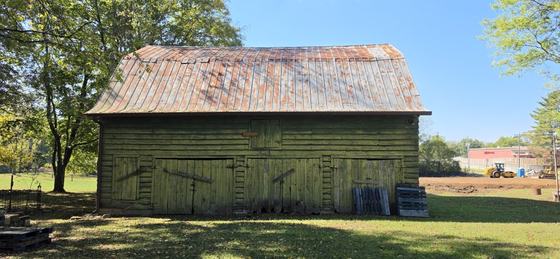
 Gambrel barn 7 photos
Monteagle, TN
Church-Owned Gambrel Barn on the Cumberland Plateau
Make an offer Barn to move
Listed Oct 2026
Tennessee has barns found almost nowhere else, like the cantilever barns of East Tennessee and the dark-fired tobacco barns of the Black Patch.
Barns posted by their owners, newest first. Most are sold to be taken down and moved. Click a barn for its photos, size, age and the seller's terms.
Tennessee farm real estate averaged $6,500 an acre in 2026, up 5.7% in a year, one of the larger gains among the states and well above the US average of $4,500. Pasture is nearly as valuable as cropland ($5,910 against $6,400 an acre), driven by demand for small farms around Nashville, Knoxville and Chattanooga.
Tennessee keeps a careful record of its old farms. The Tennessee Century Farms program, created in 1975 and run by the Center for Historic Preservation at Middle Tennessee State University, documents farms held by one family for 100 years or more, including Pioneer Century Farms founded before statehood in 1796.
| Land type | Tennessee | US average |
|---|---|---|
| Farm real estate (land and buildings) | $6,500 | $4,500 |
| Cropland | $6,400 | $6,020 |
| Pasture | $5,910 | $2,000 |
| Change in farm real estate, 2025 to 2026 | +5.7% | +3.4% |
Source: USDA NASS, Land Values 2026 Summary, released July 31, 2026. Tennessee farm real estate is 44% above the US average.
Sevier and Blount counties have most of the surviving cantilever barns, log cribs with a huge upper story that overhangs the cribs on cantilevered beams, built from the mid-1800s to the early 1900s. They are rare and seldom sold.
The valleys around Greeneville, Jonesborough and Rogersville grew burley tobacco, and their large frame air-cure barns with vented siding stand on many farms. Mountain land near the Smokies carries cabin prices.
The Nashville Basin is horse country, home to the Tennessee Walking Horse around Shelbyville, and its farms have horse barns, dairy barns and frame hay barns. Williamson and Rutherford counties have suburban prices; Maury, Marshall and Bedford are more rural.
North of Nashville, Robertson and Montgomery counties are in the Black Patch, where dark tobacco is fire-cured. Dark-fired barns are tall and tightly built, and their interiors are blackened by decades of smoke.
On the Cumberland Plateau, farms around Monteagle, Altamont and Tracy City are small and mixed with woodland, and their barns are modest frame and log buildings. One listing on this site, a church-owned gambrel barn in Monteagle, is offered for removal.
West Tennessee was cotton country, and its flat farms in Haywood, Fayette and Tipton counties have cotton-era barns and outbuildings at some of the lowest prices in the state.
Our old barn inspection checklist covers the rest, and the guide to moving an old barn explains the costs if you plan to take one down and re-erect it.
Restoring a listed barn for business use may qualify for the 20% federal historic tax credit; see our barn tax credit guide.
A barn with one or two log cribs on the ground and a much larger upper story that overhangs them on long cantilevered beams. Most of the survivors are in Sevier and Blount counties in East Tennessee.
Burley tobacco is air-cured, so its barns have vents or gaps in the siding to let air through. Dark tobacco in the Black Patch is cured over slow fires, so dark-fired barns are tight buildings with smoke-blackened interiors.
Tennessee farm real estate averaged $6,500 an acre in 2026, according to USDA, up 5.7% from 2025. Land near Nashville and the Smokies costs more; West Tennessee farmland costs less.
List your Tennessee barn on OldBarnsForSale.net for free and reach buyers looking for old barns.
List Your Barn