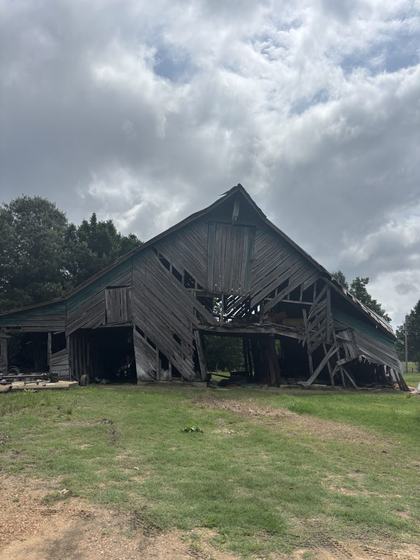
 Gable barn 8 photos
Wynne, AR
Old Gable Barn with Braced Timber Frame
Ask the seller Barn to move
Listed May 2026
Arkansas splits into the Ozark and Ouachita hill country, with log and crib barns, and the flat Delta, with cotton, rice and soybean farm buildings.
Barns posted by their owners, newest first. Most are sold to be taken down and moved. Click a barn for its photos, size, age and the seller's terms.
Arkansas farm real estate averaged $4,350 an acre in 2026, up 2.4% in a year and just under the US average of $4,500. Cropland averaged $3,850 and pasture $3,500. Pasture here is worth almost as much as cropland because so much hill-country land sells for cattle and homesites.
Arkansas barns follow the line between the uplands and the lowlands. The Ozark and Ouachita hills in the north and west were settled by small farmers from Tennessee, Kentucky and the Carolinas, who built log and frame barns. The Delta in the east was cotton plantation and tenant-farm country and later turned to rice and soybeans, so its farm buildings are larger and plainer.
| Land type | Arkansas | US average |
|---|---|---|
| Farm real estate (land and buildings) | $4,350 | $4,500 |
| Cropland | $3,850 | $6,020 |
| Pasture | $3,500 | $2,000 |
| Change in farm real estate, 2025 to 2026 | +2.4% | +3.4% |
Source: USDA NASS, Land Values 2026 Summary, released July 31, 2026. Arkansas farm real estate is 3% below the US average.
The Ozark counties across northern Arkansas, including Boone, Carroll, Madison, Newton, Searcy, Stone, Izard and Fulton, were settled in the first half of the 1800s by Upland South families. Their oldest barns are single and double-crib log barns, followed by transverse-crib frame barns with a center aisle and side sheds, built of native oak and other hardwoods.
Benton and Washington counties in the northwest have grown fast around Bentonville, Rogers and Fayetteville, and old farms there now sell as development land. The hill counties to the east are cheaper, with small cattle farms where old barns are often still in use for hay.
The Arkansas River Valley between Fort Smith and Little Rock, through Crawford, Franklin, Johnson, Pope and Yell counties, mixes hill farms with bottomland. Barns here are a blend of Ozark log and frame barns and the larger cotton-era barns of the lowlands.
South of the river, the Ouachita Mountains in Polk, Montgomery, Scott and Garland counties are mostly timber and cattle country, with scattered small barns on old homesteads.
The flat Delta counties along the Mississippi River, such as Mississippi, Crittenden, Poinsett, Cross and Phillips, were cotton plantation country and then large row-crop farms. Their surviving farm buildings include cotton gins, commissaries, mule barns and tenant-farm outbuildings, many abandoned as farms grew larger.
The Grand Prairie around Stuttgart has grown rice since the early 1900s and is the center of the largest rice-growing state in the country. Delta land is valuable cropland, but the old buildings on it are often treated as obstacles, so they can sometimes be bought for removal.
Our old barn inspection checklist covers the rest, and the guide to moving an old barn explains the costs if you plan to take one down and re-erect it.
Restoring a listed barn for business use may qualify for the 20% federal historic tax credit; see our barn tax credit guide.
Arkansas farm real estate averaged $4,350 an acre in 2026, according to USDA, with cropland at $3,850 and pasture at $3,500. Land in northwest Arkansas around Bentonville and Fayetteville costs well above that, while the hill counties farther east are usually cheaper.
The oldest are single and double-crib log barns built by settlers from Tennessee and Kentucky. Later barns are mostly transverse-crib frame barns with a center aisle and side sheds, built of native hardwoods.
Contact the Arkansas Historic Preservation Program, which reviews whether properties are eligible for the National Register or the Arkansas Register. A county historical society can often add the farm's family history.
List your Arkansas barn on OldBarnsForSale.net for free and reach buyers looking for old barns.
List Your Barn